Imagine a world where fans can own a piece of their favorite song’s future earnings, artists receive real-time royalty payouts, and every transaction is forever etched on a public ledger. This is not science fiction - it’s the new reality of on-chain music royalties, powered by blockchain technology and tokenization. As the music industry evolves in 2025, platforms like Royal. io, Audius, Anotherblock, and Bolero are transforming how revenue streams flow between creators and their supporters.
From Soundwaves to Smart Contracts: The Mechanics of Tokenized Music Royalties
At its core, tokenization enables artists or rights holders to convert a portion of their music rights into digital tokens, most commonly as Non-Fungible Tokens (NFTs). Each token represents a fractional claim on the future royalty revenue generated by the underlying song or album. Fans and investors can purchase these tokens directly from the artist or on secondary markets, gaining exposure to both streaming and licensing income.
The real innovation lies in smart contracts. These self-executing programs live on the blockchain and automatically distribute royalty payments to token holders according to pre-set rules. This means no more waiting months for a check from an opaque label system - payouts are transparent, auditable, and can even be delivered in real time as revenue is collected.
The New Marketplace: Platforms Leading On-Chain Royalty Distribution
The rise of NFT music royalties has given birth to specialized platforms that facilitate this new form of fractional ownership:
Leading Platforms for Tokenized Music Royalties
- Royal.io: Co-founded by musician 3LAU, Royal.io enables artists to sell fractionalized music rights as digital tokens. Fans can purchase these tokens to receive a share of streaming royalties, with major artists like Nas and The Chainsmokers participating. Learn more.
- Audius: Audius is a decentralized music streaming platform that leverages blockchain to compensate artists directly using its native token, $AUDIO (current price: $0.0564). It offers higher per-stream payouts and greater transparency compared to traditional streaming services. Explore Audius.
- Anotherblock: Anotherblock allows rights holders to tokenize and sell shares of traditional music royalty streams as NFTs. Fans can invest in these tokens and receive proportional royalty payments, democratizing access to music revenue. Visit Anotherblock.
- Bolero: Bolero focuses on fractionalizing music royalties into blockchain-based assets, enabling both artists and fans to participate in royalty sharing. The platform supports direct artist-to-fan engagement and transparent royalty distribution. Discover Bolero.

Royal. io, co-founded by musician 3LAU, lets artists sell limited digital assets representing streaming royalty shares. Notable adopters include Nas and The Chainsmokers. Audius, meanwhile, is a decentralized streaming service that rewards creators with its native $AUDIO token - currently priced at $0.0564 as of today. This price stability is crucial for artists assessing whether blockchain-based payouts can rival traditional models.
Anotherblock and Bolero focus on converting legacy royalty streams into NFTs tradable by fans worldwide. These platforms are democratizing an asset class once reserved for industry insiders and institutional investors.
The Appeal: Why Artists and Fans Are Embracing Blockchain Music Revenue Sharing
- Direct-to-Fan Funding: Tokenization allows musicians to crowdfund projects without label advances or debt - fans become stakeholders with a genuine financial incentive in an artist’s success.
- Transparent Payouts: Every transaction is recorded on-chain, eliminating disputes over who gets paid what and when.
- Liquidity and Flexibility: Fans can trade their royalty tokens any time on secondary markets, giving them control over their investments rather than being locked into long-term contracts.
This shift towards fractional music ownership also creates new engagement models. Fans who own tokens aren’t just passive listeners - they’re partners in the creative journey. For artists weary of opaque accounting practices or delayed payments from traditional services, this model offers unprecedented control and transparency over their income streams.
The Challenges: Regulation, Volatility and IP Rights in Tokenized Royalties
No innovation comes without hurdles. Regulatory compliance remains top-of-mind for platforms offering tokenized royalty shares. In many jurisdictions these tokens may be classified as securities, requiring adherence to financial regulations previously foreign to most musicians. Market volatility is another consideration; just as with any asset class, the value of royalty tokens fluctuates with both market sentiment and actual song performance.
Intellectual property rights add another layer of complexity. Clear legal agreements must define exactly what is being tokenized and what rights token holders possess. For instance, does a token grant a share of only streaming royalties, or does it include licensing and sync income as well? Artists and investors alike need to understand these distinctions before participating in on-chain music royalty markets.
Security is also paramount. While blockchain technology offers transparency, it is not immune to cyber risks. Smart contract vulnerabilities or compromised wallets could potentially disrupt payouts or expose sensitive data. Leading platforms are investing heavily in audits and security protocols to earn user trust and ensure the integrity of royalty flows.
Looking Ahead: The Future of Fractional Music Ownership
The momentum behind blockchain music revenue sharing is unmistakable, with more artists exploring direct-to-fan models and fans eager to participate in their favorite creators’ success stories. As regulatory frameworks mature and user experience improves, we can expect broader adoption across genres and geographies.
For artists, the promise is clear: greater control over their work, faster access to income, and the ability to build communities invested not just emotionally but financially in their art. For fans and investors, fractional music ownership opens up a new asset class, one that blends cultural passion with real financial upside.
Key Benefits and Risks of Tokenized Music Royalties
- Direct-to-Fan Investment Opportunities: Tokenization enables fans to purchase fractional ownership of music royalties, giving them a direct financial stake in their favorite artists’ success. This democratizes access to music investing, previously limited to industry insiders.

- Enhanced Transparency and Efficiency: Blockchain-based royalty distribution uses smart contracts to automate payments, ensuring timely and transparent payouts to all token holders without relying on intermediaries.

- Liquidity Through Secondary Markets: Holders of royalty tokens can trade them on secondary markets, providing liquidity and the potential to realize gains or exit positions based on music performance and market demand.
- Regulatory and Legal Uncertainty: Tokenized royalties may be classified as securities, requiring compliance with financial regulations. Unclear legal frameworks can introduce risks for both artists and investors.
- Market Volatility and Revenue Uncertainty: The value of royalty tokens can fluctuate due to changes in streaming numbers, artist popularity, or broader crypto market trends, making returns unpredictable.

- Intellectual Property and Rights Management: Clear agreements are essential to define the rights and obligations of all parties. Disputes or unclear IP rights can impact royalty distributions and token value.
The current price of Audius ($AUDIO) at $0.0564, with its recent 24-hour change of -0.8810%, serves as a real-time barometer for how blockchain-powered platforms are performing relative to traditional industry benchmarks. This level of price transparency helps both artists and investors make informed decisions about entering the market or holding existing positions.
Audius Technical Analysis Chart
Analysis by Evelyn Carter | Symbol: BINANCE:AUDIOUSDT | Interval: 1W | Drawings: 5
Technical Analysis Summary
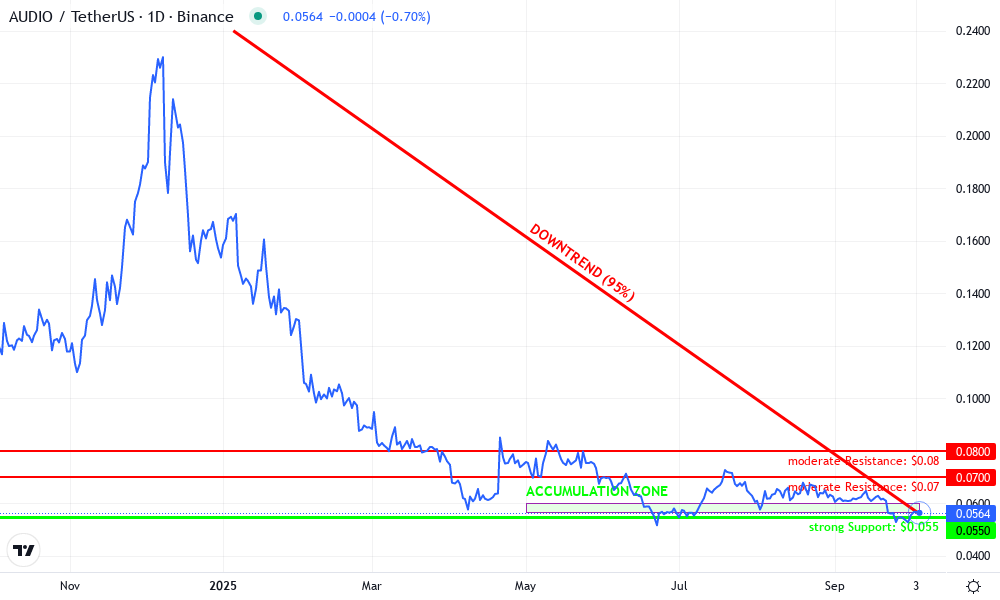
Begin by plotting a primary downtrend line from the peak near $0.2400 in early 2025 through subsequent lower highs to the current price level. Use horizontal lines to mark key support at $0.0550 and resistance at $0.0800, reflecting areas where price has historically paused or reversed. Highlight the extended consolidation/accumulation range between $0.0550 and $0.0700 from May to October 2025 with a rectangle. Emphasize the most recent price action near $0.0563 with a callout noting the low volatility and potential base formation. Given the conservative approach, avoid marking speculative breakout levels until a confirmed reversal is observed.
Risk Assessment:high
Analysis: AUDIO remains in a pronounced downtrend, hovering near multi-month lows.No clear sign of reversal, and support at $ { { { { { { { { { { { { { { { { { { { { { { { { { { { { { { { { }}}}}}}}}}}}}}}}}}}}}}}}}}}}} is critical.Market conditions for music royalty tokens are fundamentally promising but technically fragile.
Evelyn Carter's Recommendation: Given the high risk and lack of clear reversal, I recommend waiting for a confirmed bottom and trend change, supported by both technical and fundamental catalysts, before considering any allocation—even for speculative purposes.For retirement or portfolio strategies, prioritize capital preservation and avoid premature entries.
Key Support & Resistance Levels
📈 Support Levels:
- $ - Major support,tested multiple times since May2025.A breakdown below may accelerate downside.strong
📉 Resistance Levels:
- $ - First significant resistance, marking the upper bound of the recent accumulation zone.moderate
- $ - Next resistance level, where the price last encountered selling pressure in July2025.moderate
The next phase will likely see deeper integration between streaming platforms, NFT marketplaces, and even social media, allowing seamless buying, selling, and trading of royalty tokens directly within the apps where fans already spend their time. We’re also seeing experiments with dynamic payouts: as songs go viral or enter new markets, smart contracts can instantly adjust distributions based on actual performance data.
“The democratization of music royalties isn’t just about better payments, it’s about rewriting who gets to participate in the value creation process. ”
While challenges remain around regulation and education, the trajectory is clear: on-chain music royalties are reshaping how value flows through the creative economy. Artists now have tools to monetize their work on their own terms; fans have unprecedented access to both culture and cash flow; investors have a new way to diversify into digital assets tied directly to real-world performance.
Tags
Related Articles
How to Tokenize Songwriter Royalties as NFTs for Fractional Ownership on Blockchain 2026
Imagine turning your songwriter royalties into a digital asset that fans and investors can own a piece of, all secured on the blockchain. In 2026, tokenize songwriter royalties as NFTs has become a game-changer, letting creators unlock...
Mar 24, 2026
Tokenized Music Royalties as RWAs: How Opulous Enables Artists to Sell Revenue Streams to Fans
In the evolving landscape of real-world assets (RWAs), tokenized music royalties stand out as a compelling blend of cultural passion and financial opportunity. Platforms like Opulous are pioneering this space, allowing artists to convert...
Mar 17, 2026
Tokenized Music Royalties Case Study: Diplo Shares Streaming Revenue via Royal Tokens
In the evolving landscape of tokenized music royalties , few case studies shine as brightly as Diplo's collaboration with Royal. Back in March 2022, the Grammy-winning DJ disrupted traditional music revenue models by tokenizing streaming...
Feb 17, 2026
How Diplo Tokenized Streaming Royalties on Royal Blockchain Platform for Fan Ownership
In the ever-evolving landscape of music ownership, Grammy-winning DJ and producer Diplo made waves in March 2022 by tokenizing streaming royalties for his single "Don't Forget My Love" on the Royal blockchain platform. This move allowed...
Feb 16, 2026
No comments yet. Be the first to share your thoughts!